If you live with an autoimmune or chronic condition, you've almost certainly had the thought: some days are worse and I don't know why. The good news is that the answer is usually hiding in things you already do — how you slept, what you ate, whether you took your meds, what your labs are doing. You just have to put the pieces next to each other. Here's the method, honestly — including where it can fool you.
Start with one question, not a spreadsheet
The mistake is trying to track everything and stare at all of it. Instead, start with a single question you actually care about: "Does bad sleep make my joints worse the next day?" or "Do flares follow the days I eat dairy?" One symptom, one suspect. A specific question is something you can answer; a wall of data is not.
Put two things side by side
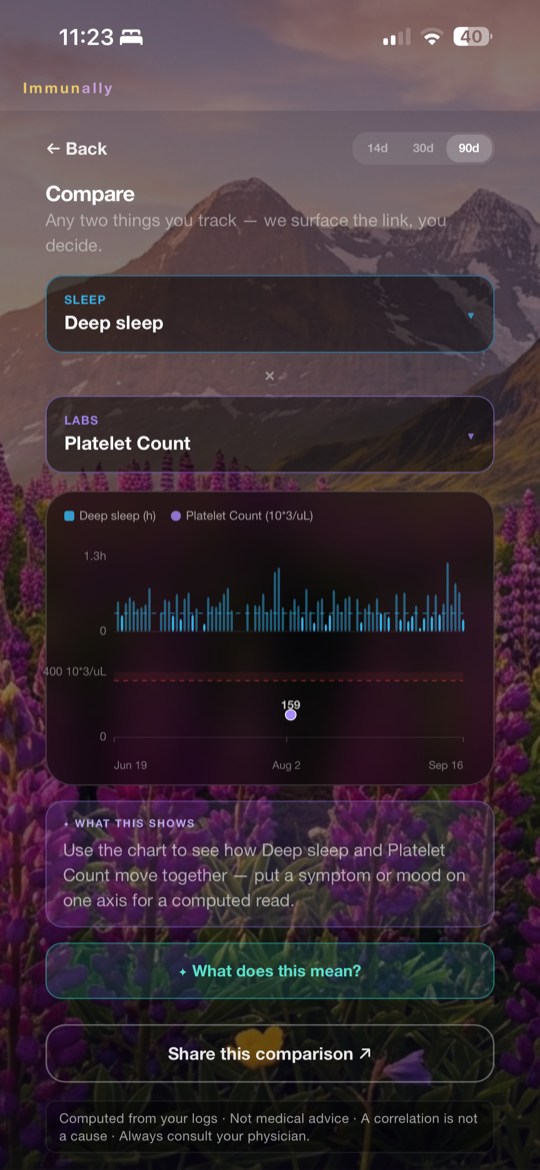
Once you have your question, the whole trick is comparison: line up the symptom against the one thing you suspect, over the same stretch of time, and look at them together. That's exactly what Immunally's Compare does — pick a symptom, pick a factor (your sleep, a food, a lab value, a medication), and it overlays them on one chart so you can see at a glance whether they rise and fall together, instead of scrolling back through weeks of entries in your head.
Look at the timing, not just the day
This is the part most people miss. Your body doesn't always react the same day — a rough night can hit your joints tomorrow, and a food can take a day or two to show up. So when you compare, don't only look for things happening together; look for one reliably following the other after a lag. A one-day shift in the pattern is often the real story, and it's the kind of thing that's invisible until you see the two lines drawn against each other.
The traps — where patterns fool you
A pattern is a lead, not a verdict. Before you believe one, run it past these:
- Correlation isn't cause. Two things moving together can be coincidence — or both driven by a third thing (a stressful week wrecks your sleep and your gut at once).
- One instance proves nothing. Feeling awful once after dairy is a story, not a pattern. Look for it to repeat.
- Watch for confounders. If three things changed at once, you can't credit just one. Change less, and you'll learn more.
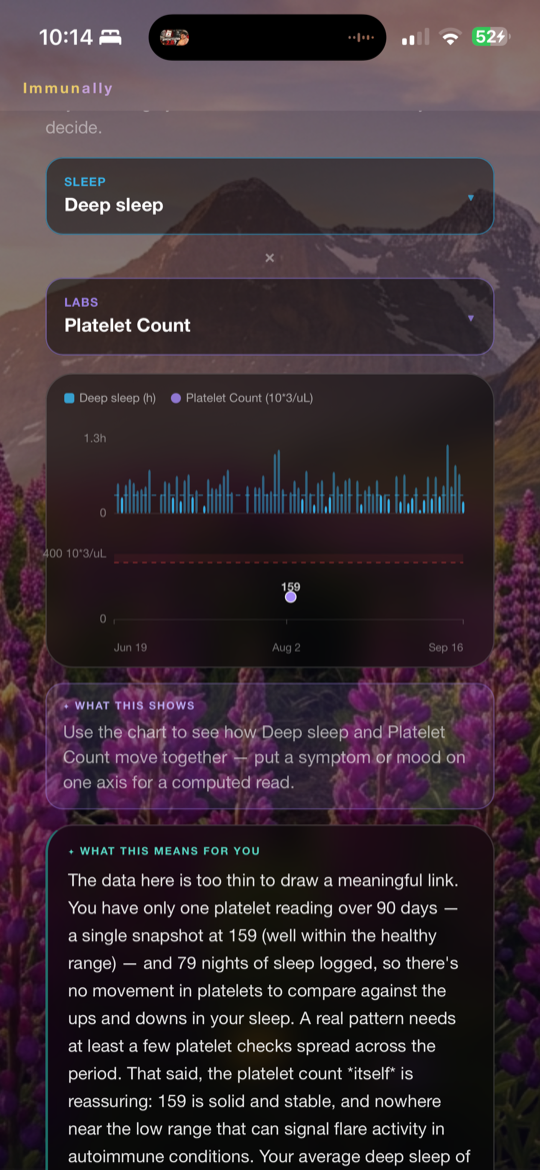
- Small samples lie. A handful of days can hint, but give a real pattern a couple of weeks of consistent logging before you trust it.
This is why Immunally uses careful language. When it surfaces something, it calls it a signal to look at — never a diagnosis, never "X caused Y." A signal is an invitation to test, not a conclusion.
Turn a hunch into something you can trust
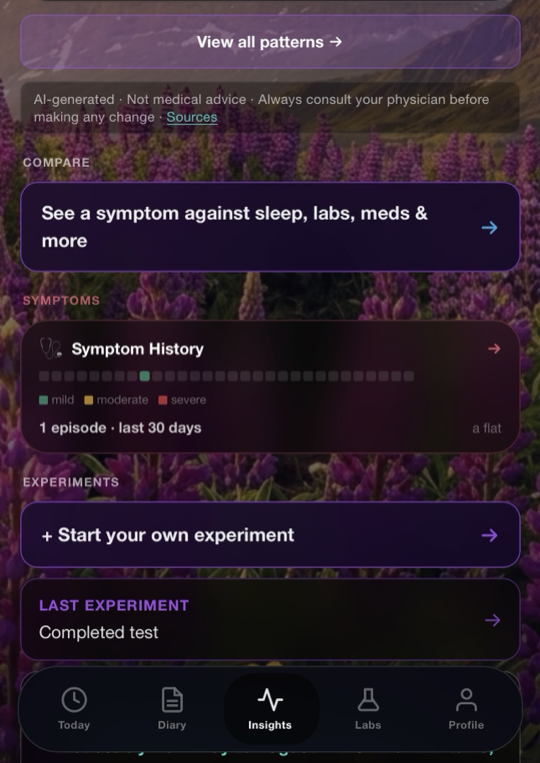
When a comparison keeps pointing the same way, stop guessing and test it. Change the one variable for a short, defined window — cut the suspected food for two weeks, or protect your sleep — and watch whether the symptom follows. That's an experiment, and it's the difference between "I think dairy bothers me" and "I checked." Immunally lets you run that as a simple before-and-after so the result is clear instead of a vibe.
Bring it to your doctor — with the receipts
Finding a pattern yourself doesn't replace your care team; it makes your appointments better. Walking in with "my joint pain tracks my sleep, and here are six weeks of it" is worth far more than "I've been feeling off." Immunally builds a summary you fully control — pick the categories and the date range, and it pulls together your symptoms, your vitals and lab results with dates, and your current medications and doses into one thing you can hand over.
Find the pattern yourself.
Log your days by voice, a quick note, or a photo. Then compare any symptom against your sleep, food, labs, or meds, test what you find, and share it with your doctor — insights in your own data, in your hands.
Immunally is a tracking and insight tool, not a medical device, and doesn't diagnose or treat any condition. Patterns and signals are for your own understanding and discussion with a professional — always consult your healthcare provider before making changes to your care.
Frequently asked questions
How do I find patterns in my symptoms myself?
Start with one question, not a spreadsheet. Pick one symptom and one thing you suspect affects it, put the two side by side over time, and look for whether they move together — including with a delay. Immunally's Compare view overlays any symptom against your sleep, food, labs, or medications so you can see it at a glance.
How many days of tracking before patterns show up?
A single instance never proves anything — you want the pattern to repeat. A few days can surface an early signal worth watching; a couple of weeks of consistent logging is usually enough to tell a real association from noise. Easy logging is what keeps the record complete enough to trust.
Does a pattern mean something caused my symptoms?
No. A pattern is a lead, not a verdict — two things moving together can be coincidence, or both driven by a third thing. The honest next step is to test it: change one variable for a short window and see if the symptom follows, then bring what you find to your doctor rather than acting on it alone.